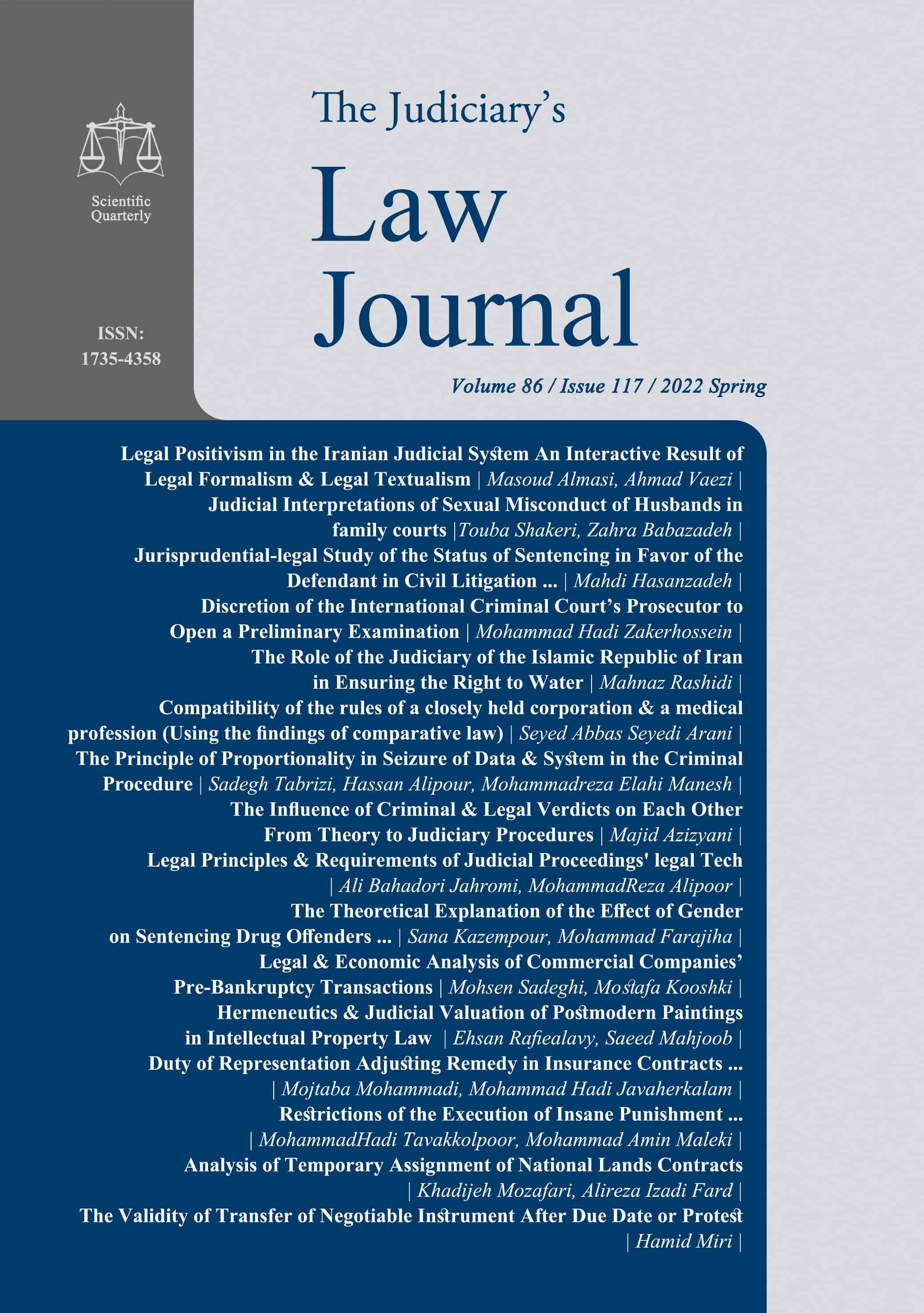
The modern legal system in Iran has always been influenced by the textualism movement and legal formalism. The interactive resultant of these two currents has led to a kind of legal positivism in the Iranian judicial system, according which judges must present their judgment with formal judicial logic and within the framework of legal textualism. These assumptions lead us to the main question of this article, which is the nature of legal textualism and legal formalism and how they affect the rule of legal positivism in the Iranian judiciary System. In this article, we will first use a descriptive method to discuss the concept of legal textualism and legal formalism and legal positivism in order to be able to analyze the rule of paradigm based on these concepts on the Iranian judicial system and its consequences. The findings of this study will reveal that the rigid approach to law and the method of judicial inference is not always in line with legal ideals and justice. The other findings of this study will reveal interactive resultant of the textualism movement and legal formalism in the Iranian judicial system is the rule of kind legal positivism, which has confused the ontological, epistemological and anthropological foundations of legal systems based on the principles of modernity with the Islamic legal system in several principles of the constitution and ordinary laws.
Beccaria, Cesare, (2012), On Crimes and Punishments and Other writings “The interpretation of the laws (Chapter 4)”, Edited by Richard Bellamy, Translated by Richard Davies, Cambridge, Cambridge University Press.
Hart, Herbert Lionel Adolphus, (1985), Positivism and the Separation of Law and Morals, (1958) Harvard Law Review, Vol. 71, No. 4.
Kennedy, Duncan, (1973), Legal Formality, The journal of legal studies. Vol. 2, No. 2.
Leiter, Brian, (2010), Legal Formalism and Legal Realism: What Is th Issue?, Legal Theory, Vol. 16, No. 2.
Mann, Bruce Hartling, (1994), Formalities and Formalism in the Uniform Probate Code, University of Pennsylvania Law Review, Vol. 142, No. 3
Marmor, Andrei&Soames, Scott (eds), (2011), Philosophical Foundations of Language in the Law, Oxford, Oxford University Press.
Marmor, Andrei, (2007), Law in the Age of Pluralism, Oxford, Oxford University Press.
Perry, John, (2011), Textualism and the Discovery of Rights, in: Philosophical Foundations of Language in the Law, Oxford, Oxford University Press
Posner, Richard A., (1986), Legal Formalism Legal Realism and the Interpretation of Statutes and the Constitution, Case Western Reserve Law Review, Volume 37, Issue 2.
Schauer, Frederick, (1988), The Yale Law Journal, Vol. 97, No. 4.
Siegel R., Jonathan, (2009), The Inexorable Radicalization of Textualism, University of Pennsylvania law review, Vol.158.
Steven Green, Michael, (2005), Legal Realism as Theory of Law, William & Mary Law Review, Volume 46.
Tebbit, Mark, (2005), Philosophy of Law: An Introduction, 2nd Edition, London, Routledge Hardcover.
Trevino, A. Javier, (2008), The Sociology of Law Classical and Contemporary Perspectives, New York, Routledge, 1st Edition
Weinrib, Ernest.J, (1988), Legal Formalism: On the Immanent Rationality of Law, Yale Law Journal, 97, No. 6.
Weinrib, Ernest.J, (2010), Legal Formalism in; A Companion to Philosophy of Law and Legal Theory, Edited byDennis Patterson, Second edition, United States Blackwell Publishing.
Amasi,M and Vaezi,A . (2022). Legal positivism in the Iranian judicial system is the interactive result of legal formalism and legal textualism. The Judiciarys Law Journal, 86(117), 1-19. doi: 10.22106/jlj.2021.527673.4077
MLA
Amasi,M , and Vaezi,A . "Legal positivism in the Iranian judicial system is the interactive result of legal formalism and legal textualism", The Judiciarys Law Journal, 86, 117, 2022, 1-19. doi: 10.22106/jlj.2021.527673.4077
HARVARD
Amasi M, Vaezi A. (2022). 'Legal positivism in the Iranian judicial system is the interactive result of legal formalism and legal textualism', The Judiciarys Law Journal, 86(117), pp. 1-19. doi: 10.22106/jlj.2021.527673.4077
CHICAGO
M Amasi and A Vaezi, "Legal positivism in the Iranian judicial system is the interactive result of legal formalism and legal textualism," The Judiciarys Law Journal, 86 117 (2022): 1-19, doi: 10.22106/jlj.2021.527673.4077
VANCOUVER
Amasi M, Vaezi A. Legal positivism in the Iranian judicial system is the interactive result of legal formalism and legal textualism. The Judiciarys Law Journal. 2022;86(117):1-19 (In Persian). doi: 10.22106/jlj.2021.527673.4077